Shortly after I descended from the smoggy heights of Kuala Lumpur’s iconic Petronas Towers, I made my way to the dross-sounding, Malaysia National Museum (Muzium Negara).
I say dross, because I often discover that museums dedicated to national identity, have that rare ability to hypnotise me with officialised blandness. Malaysia’s is no different, but I was left with a residual sense of obscurity, which I neither expected nor welcomed.
Malaysia National Museum (Muzium Negara)
From the outside, the Malaysia National Museum is a rather stale example of Malay architecture, which has been bastardised by concrete and a fashion of orderly. Its main exhibitions are adequately informative (a consistent theme through Malaysia’s many museums), but you do leave feeling a little, flat.
Unless perhaps you’re Malaysian, which grants you an obligatory devotion to your country’s undulating history. You should, I assume, have a patriotic knowledge of the many black-and-white heroes displayed in the foyer, and have an unnatural obsession for archaeology.
I jest of course, for Malaysia is a country that has been twisted and torn by empires of old and new. A burning tinge of communist suppression, and a trifle too much European colonialism undermine a country which has succeeded, more than most, in achieving that holy grail of societal style: multiculturalism.
The current government is fervently promoting their 1Malaysia campaign, extolling the many virtues of accepting multiculturalism at every level. Politics aside, it makes an interesting topic of conversation, with the overriding reaction from (mostly Malay) people I spoke to, being that they “Don’t need to be told to be multicultural,” because in their eyes they have been their entire lives.
As I pondered this thought, I leaned against a balcony in the heart of the museum, and watched with interest, the way domestic tourists avoided observing the exhibitions. It was a blend of sideways glances and subtle quicksteps, as they floated effortlessly passed neat rows of glass cabinets. It appeared the act of visiting this museum, was an inconvenient necessity.
The irony for me, was that those visitors skimming passed Muzium Negara’s exhibitions, soon become the most interesting exhibit. This illusion isn’t exclusively a Malaysian speciality; as I said in my opening, national museums very rarely enthral me.
The other reason I am so fluidly undermining the part this museum has in the landscape of Malaysia was found in a corner of the museum grounds, where I — quite literally — discovered one of my pet hates.
Malaysia’s Belittlest Pet Shop
The room was small, but pocked with odorous glass tanks filled with creatures from around the globe. “Is that an Australian wallaby?” I asked one of the spindly young Russians who was eyeing me and my dormant camera with disdain from across the room. “I think from New Zealand,” he buzzed.
I instantly disliked everyone in the room.
My imagination went into overdrive, and I concocted a story whereby this Russian and his pale friend had smuggled the wallaby out of New Zealand on an iron ark. Perhaps after a ferocious storm, they washed ashore in Kuala Lumpur, where they were forced by the Mafia to take a job in the National Museum’s pet store (until such time as they could pay for their next mission).
I circled the room, and spotted a pair of hedgehogs huddled into the corner of a glass tank, no larger than thirty centimetres cubed. They were curled up in a ball, with neither a place to snuffle, nor play. Stuck to the glass above their prickles, a handwritten sticker displayed their worth: RM180 (£36).
If I were a hedgehog, I think I would be quite proud of this valuation, although I presumed the nearby Asian forest scorpions may have been a little put out by their own meagre RM25 (£5) price tags.
The occupants of neighbouring confines spent their days in silent contemplation; minute frogs and spindly snakes, hairy-limbed spiders, puppies and perhaps the biggest surprise of all, a pair of stowaway skunks.
A Quick Overview of My Stance
If you have not already realised it from reading TrailofAnts.com throughout the years, I’m not a fan of needless animal cruelty. I accept that animals will be bought and sold, but see little reason in their unnatural confinement.
Many of you know, I do not visit zoos or aquariums for this very reason. Once again, I accept that some zoos may contribute a nominal amount of their time and profit to conservation and preservation, but when I think about that elephant schlepping around his central London enclosure, or any of the world’s amazing animal kingdom, being taunted by podgy children, I find little reason for cheer.
The world’s a fine enough zoo, without boxing everything up. I’ll taper off the subject, as my intention is to portray, not preach. Much.
Snake versus Snake
I often make hypocritical mistakes with my standpoint, and the next exhibition was a good example of this.
Titled ‘Snake vs. Snake’, I had wrongly presumed the exhibition was a series of photographs portraying battles between anacondas and pythons, or perhaps what might happen when rival cobras encounter each other in the wild.
Seconds after I paid the RM8 (£1.60) entrance fee, I was smiled at by an attractive young Malaysian woman. She was dressed in tight, funky clothing and would not have looked out of place in an X Factor audition.
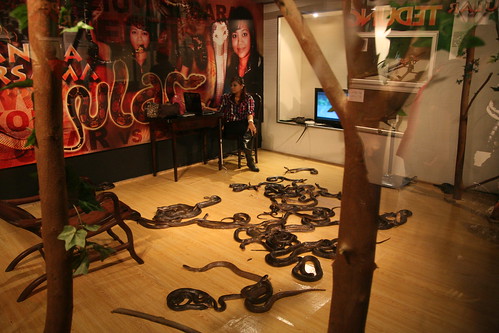
Only, Azha wasn’t auditioning for anything, because in her eyes she was already the star of the show. Enclosed within a sizeable room, with glass walls on two sides and a laminate floor, Azha the Snake Queen flicked her gaze between a plasma TV screening Malay pop, and her laptop.
Strewn across the floor were three dozen or more cobras.
I watched Asha for twenty minutes, as she intermittently dragged the snakes around with a large hook, before returning to her seat. I concentrated my mind, and with all my might, I willed the cobras to rise up against her in an act of reptilian rebellion.
Alas, they just slumped there; like scribbles, on the footnote of greatness.
My discomfort at having paid to see this was severely accelerated when I saw the rest of the exhibition, and discovered snakes of every size squished into tanks barely large enough to hold their lunch, let alone the snakes themselves.
To accentuate the lack of consideration for the snakes, the overriding theme of the exhibition was that snakes are terrible, and at worst they are humankind’s most feared enemy. This was echoed by the large screen showing the nastiest clips from films such as Snakes on a Plane, Boa vs. Python and Anacondas.
Lasting Memories
As I left the room, I watched a large Muslim family stretch out a large golden python for a family photo. I saw how happy the children were; and a glint of fear in the mother’s face, absorbed by the outward pride of the children’s beaming father.
I considered what that moment must have meant to them, and how that photograph would be pointed out with vigour in the family album for many years to come.
For a moment, I accepted it as a part of life. Then I considered how the snake felt, and wondered if it would ever be invited into the 1Malaysia equation.



{ 4 comments… read them below or add one }
You’ve hit upon the Asia / African …. okay (make it easier) non European decent countries vs of European decent. And, there treatment of animals.
And, I agree with you. Nothing worse than seeing some idiot leave his dog chained up in a yard for it’s entire life. And then claim to love it. Sure he does.But, it’s not a good love.
Ditto for these animal sideshows. Worst was in Ghana whereby the local kids would throw stones at chimps in a cage. I threw stones back at them and ask how they liked it.
I hope the memory stays with them.
I applaud your reaction, Dave. Makes me wish I’d snatched that hook of the Snake Queen and started prodding and pulling her about.
I think one of my most frustrating experiences was in Sri Lanka; I took an hour long journey to go and meet a man who supposedly developed anti-venoms for snakebites.
Only, when I got there I found most of the snakes were constrictors (therefore hardly venomous, if at all) and he would take great happiness in taunting the vipers, so they would strike at him. Only, they were behind a wire meshing so their ‘noses’ would be bloodied by the impact.
The strange thing was, this man was proud of something else; his inclusion in the Lonely Planet Sri Lanka guide!
Hmm.. This is really interesting and something I have been thinking about for a while now. Traveling in Europe even has been an eye-opener for me. People love their dogs but they don’t keep them clean or feed them properly, in my opinion anyway. The animals never go in the house either because they are ‘dirty’. Yes, they are – that’s why you have to clean them! I was taken aback at how filthy most dogs were in Europe but I did notice they were loved dearly. It’s just very different than how I think things should be. I tried my best just to give extra love to the really dirty ones. However when I showed people pictures of my dog in his little striped shirt – they thought I was insane!
I can’t handle animal cruelty of any sort and even though I applaud good zoo’s for helping animals (especially the ones that can’t be released) I still tear up when I see the gorillas.
No arguments here, Bethany. It’s an international problem, which is often exhausting to open discussion on.
I hear stories all the time of individuals or small organisations doing things to help clear strays off the street (like this recent Malaysian example) but until the critical mass is educated about the need (for their own health) to look after domestic animals and livestock in a satisfactory manner, then the problem will continue.
I’m not an activist, but travelling in Asia really opened my eyes to the lowly position most of the population of that continent perceives animals to be. It triggered my girlfriend, Reb to turn vegetarian, and for many months I did also.
I’m not saying the people of Asia are consciously negligent, but the issue does appear to be the proverbial, “Elephant in the Room” for visiting tourists (pun intended).
You must log in to post a comment.